Spring Patio Lighting Ideas With Outdoor String Lights

Your December Lights Have A Second Job
A patio you can use after dark is a bigger patio. The outdoor LED strings you hang on the house in December are exactly the right tool: they're built for indoor or outdoor use, they draw almost nothing, and they connect end to end so one outlet covers the whole space. Here are four ways to lay them out, then a zone-by-zone plan and the practical notes that keep them up all summer.
1. Overhead Runs For An Outdoor Room

String lights overhead define a ceiling, and a ceiling makes a patio feel like a room. Run warm white string lights in parallel lines or a zigzag between pergola beams, posts, or hooks on the house and a tree. If you don't have anchor points, a pair of posts set in planters filled with concrete works. Keep the lines taut and at least 8 feet up so nobody ducks.
2. Overhead Runs For Entertaining
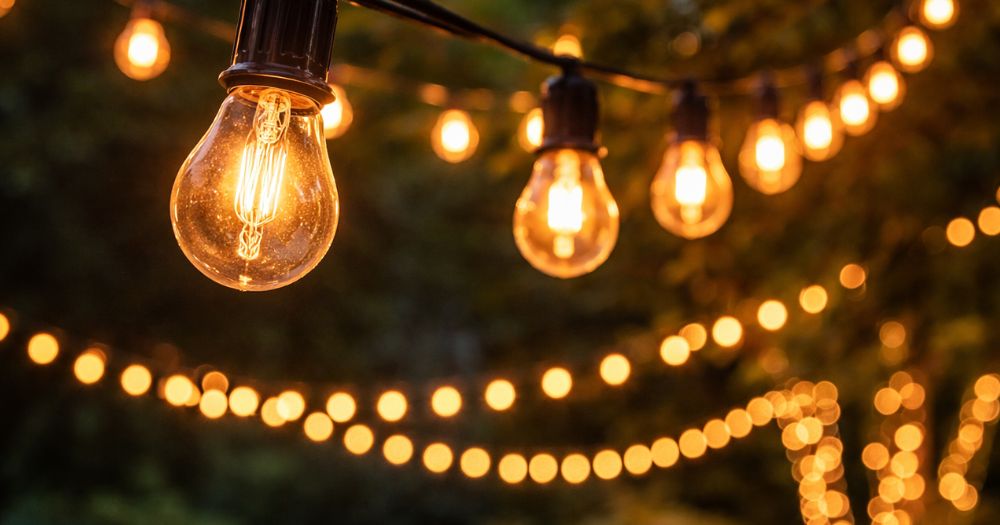
For a dining area, a single long string in a gentle swag from the house to a post over the table is enough. Larger lenses read better here: C7 bulbs on a stringer, or G12 and C6 strings, give you distinct points of light overhead rather than a wash. Warm white, always, for a dining space; it flatters food and faces.
3. Wrap Trees And Greenery
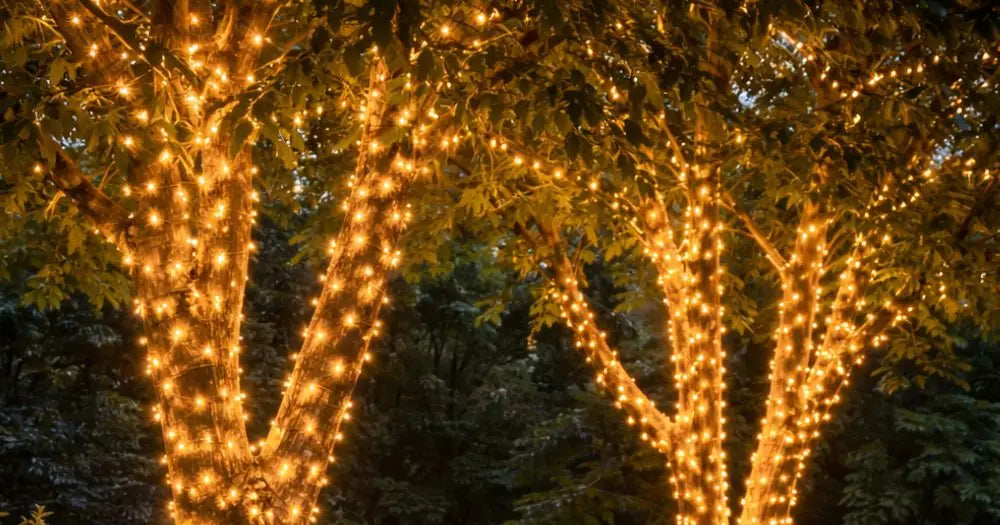
Wrap the trunk of the nearest tree with a 5mm string at 4-inch spacing and carry it out along one or two low branches. It adds depth behind the seating area and gives the eye somewhere to go beyond the patio edge. Weave a string through a hedge or a row of planters for the same effect at ground level.
4. Line The Walkway
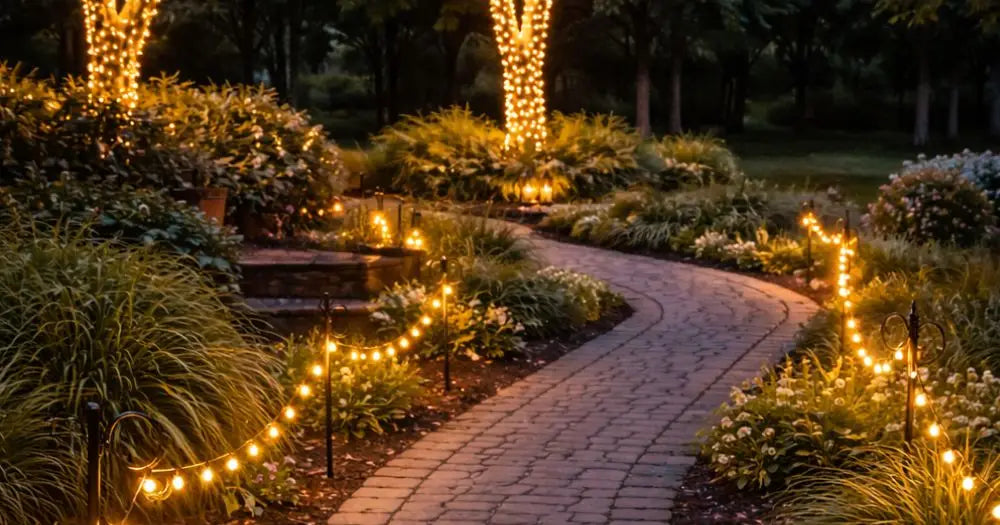
Rope light on lawn stakes along the path from the door to the patio, or a string on stakes at every socket, keeps guests off the flowerbed and connects the house to the seating area at night.
A Zone Plan
Dining: one overhead swag, warm white, larger lens. Lounge: parallel overhead lines or a zigzag, dimmer and more even. Garden feature: one wrapped tree or lit planter row. Fire pit: keep string lights well back and let the fire be the light; a wrapped tree behind the seating gives the area depth without competing. Path: a continuous line of rope light or staked string. That's five zones from two or three products.
Hanging Without Sag
Run a guide wire or cable between anchor points and clip the string to it with light clips or zip ties; the string never carries its own weight. Hook screws into wood posts, cable ties around metal, and an S-hook at each end so you can take the string down for a storm. Overhead runs should be taut; a slight swag is fine over a table, a sag over a walkway is a hazard.
Weatherproofing For A Full Season
Spring rain is harder on connections than December snow. Plug into a GFCI-protected outlet, seal every connection with a gasket from our cord protection collection, form a drip loop so water runs away from the plug, and keep connections off the ground. Put everything on a photocell timer so it comes on at dusk and off at a set hour without anyone touching it.
Color
Warm white is the default for a patio; it's the color of candlelight and it flatters everything. Cool white reads crisp and modern and suits a contemporary house. For a party, one ColorCraft® palette string woven through the planters adds coordinated color without turning the patio multicolor.
Frequently Asked Questions
Can I use Christmas lights on the patio?
Yes. Outdoor LED strings are built for indoor or outdoor use in any month. Only the layout changes.
Which lights are best overhead?
C7 bulbs on a stringer or G12 and C6 strings for distinct points of light; 5mm strings for a softer wash and for wrapping.
How many strings do I need?
Measure each overhead run and add 10 percent for swag. For trees and planters, our light calculator gives a count by size and spacing.
Warm white or cool white?
Warm white for dining and lounging. Cool white for a modern look or security lighting along a path.
Lights That Work In Every Season
Shop patio lighting and LED string lights — built for indoor or outdoor use, built to last for many seasons, and backed by our Reindeer Proof™ Warranty.