Spring Lighting Checklist: Replace & Refresh Your Christmas Lights Before the Rush
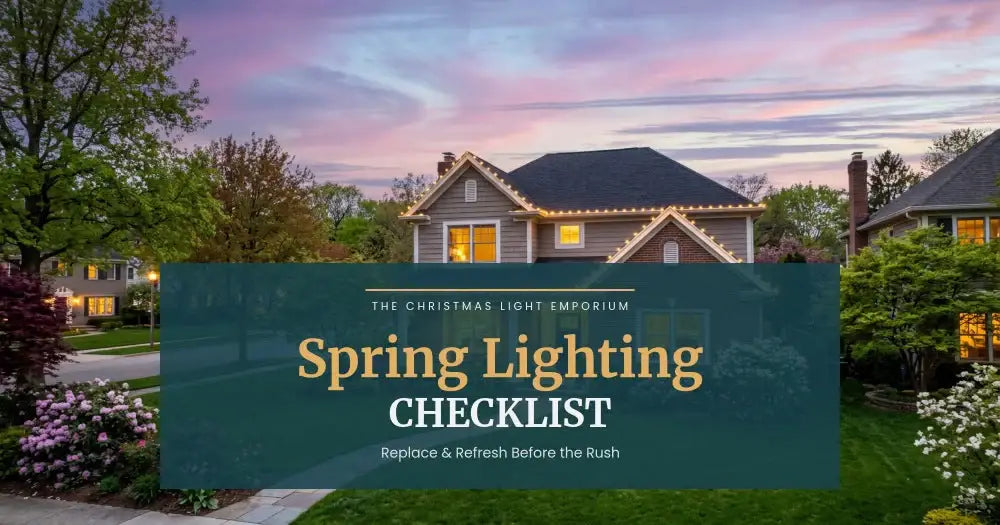
Spring is here, the decorations are packed away, and there's a small pile of sad, dimly-lit strands sitting in your garage that didn't make it through the season. Sound familiar? March and April are the best time to audit your Christmas lights, replace what's worn out, and order what you need — before September hits and everyone else is scrambling for the same strings.
Why Spring Is the Right Time to Replace Your Christmas Lights
Most people wait until November to deal with damaged lights. The problem? By then, specific colors and counts are backordered, shipping is slower, and you're making decisions under pressure. Replacing your lights in spring means you pick exactly what you want, it arrives without drama, and it's ready when you need it.
Beyond availability, spring is when you can actually see the damage clearly. Take each strand out, plug it in on the driveway, and look for dead sections, cracked bulbs, frayed wire, loose sockets, or connectors that no longer seat properly. A systematic inspection now saves hours of frustration on the roof in December.
How to Spot Lights That Need to Be Replaced
Not every dim or flickering strand needs to go — sometimes a loose bulb or a blown fuse is the issue. But here's what signals it's time to replace:
Dead Sections That Won't Revive
If a section stays dark even after swapping the bulb and checking the fuse, the wiring in that section is compromised. On older incandescent strings, this usually means a corroded shunt in a bulb socket. On LED strings, it means the controller chip in that segment has failed. Either way, it's time to replace the strand.
Cracked or Brittle Wire Insulation
Run your fingers along the length of the cord. If the insulation feels brittle, cracks, or flakes off, that's a fire and GFCI hazard — full stop. UV degradation from years of outdoor use is the culprit. Don't use those strands.
Connectors That No Longer Fit Tightly
Loose plug connections cause GFCI trips, flickering, and uneven power distribution across a daisy-chain. If a male-to-female connection wiggles, the contacts inside are worn. Replace the strand or at minimum - if your wiring is a standard pro grade SPT1 or SPT2 2-wire system - replace the connector using SPT1 male vampire plugs and a bit of fresh wire.
Faded or Mismatched Colors
LED bulbs hold their color very well, but a few years of UV exposure can cause color shift — especially in warm whites and pinks. If last season you noticed your warm white roofline looked "off" compared to new strings you added, this spring is the time to standardize. Mix-and-match color temperatures are very visible once the sun goes down.
Choosing the Right Replacement Lights
Before you order, make sure you're matching the right bulb type, count, and wire color for your existing layout. Here's a quick breakdown of the most popular choices for rooflines, trees, and bushes:
C9 Bulbs on a Stringer (Rooflines and Commercial Runs)
The standard for roofline installation is a C9 stringer with individual screw-in bulbs. This gives you flexibility — you can replace a single bulb without pulling the whole run. The most popular option is a C9 stringer in 100-foot with 12" spacing paired with ProCore® LED bulbs in your color of choice. For a clean warm roofline, C9 warm white faceted ProCore® bulbs are the go-to. If you want something that pops with color, C9 multicolor faceted ProCore® bulbs deliver a bold, saturated look.
For white wire applications (trim, fascia, or snow-covered looks), grab a C9 stringer in white wire instead.
C7 Bulbs (Pathways, Smaller Rooflines, Trees)
C7s are a step down in size from C9s — great for smaller homes, pathways, and decorative applications where C9s feel too bold. The same stringer-and-bulb setup applies. Start with a C7 100-foot stringer in green wire, and pair it with C7 warm white faceted ProCore® bulbs or C7 cool white faceted ProCore® bulbs depending on your look.
5mm LED Mini Lights (Trees, Bushes, Garland)
For trees and bushes, 5mm mini lights are the workhorse. They're bright, energy-efficient, and available in every color. If you're replacing warm white strands on a tree, the 70-count 5mm warm white LEDs are a perfect match. For cool white — great for modern or coastal aesthetics — go with the 70-count 5mm cool white LEDs. For a full bush wrap in color, 70-count 5mm multicolor LEDs are a classic choice. If you need more coverage per strand, step up to the 100-count warm white or 100-count cool white sets.
M5 Mini Lights (Dense Tree Wraps, Fine Detail)
M5 bulbs are slightly smaller than 5mm lights and produce a tighter, more uniform glow — preferred by professional installers for tree wrapping. The 70-count M5 warm white and 70-count M5 cool white are both excellent for a dense, professional tree wrap.
C6 LED Lights (Colorful, Cheerful, Medium Size)
C6 bulbs are small round strawberry-shaped LEDs — great for a casual, festive look on shrubs and small trees. The 70-count C6 warm white is a popular choice for homeowners who want something between mini lights and large C7s.
Don't Forget the Hardware
Burned-out lights aren't always the issue. Sometimes it's worn hardware — frayed socket wire, loose replacement sockets, or clips that have lost their grip. If you're rebuilding a roofline run on socket wire, pick up fresh C9 SPT1 replacement sockets in green or C9 SPT2 replacement sockets if you're on heavier wire. For custom cord repairs, SPT1 vampire plugs make it easy to splice in a new section without rewiring the whole run.
And if you're replacing clips, all-application Omni Clips work on gutters, shingles, and siding — one style for everything.
How Many Lights Do You Actually Need?
When ordering replacements, it's easy to under-order. Use these rough benchmarks to estimate your count:
- Roofline eave (C9, 12" spacing): 1 bulb per linear foot of roofline. A 100-foot eave = 100 C9 bulbs.
- Tree wrapping (5mm/M5, 4" spacing): 100 lights per vertical foot of tree trunk, spiraling up and into the canopy. A 6-foot tree typically takes 400–700 lights depending on density.
- Dense bush wrap (5mm, 4" spacing): Count the number of strands that covered the bush last year and add 10–15% for fuller coverage.
It's always smarter to order slightly more than you think you need. Running out mid-installation and waiting on a second shipment is far more frustrating than having a few extras on hand.
Frequently Asked Questions
How long do LED Christmas lights typically last?
Quality LED Christmas lights are rated for 25,000–100,000 hours of use. At typical seasonal usage (6 hours/night, 45 days/season), that's 15–30+ years of expected lifespan. However, the wire and connectors often fail before the LEDs themselves — especially with economical imported strands that use thin SPT1 wire or low-quality connectors.
Can I mix old and new LED strands on the same run?
You can, but color matching matters. Different manufacturers — and even different production batches — can produce noticeably different color temperatures for "warm white" or "cool white." If you're replacing just a few strands in a larger installation, order from the same source and check your existing strands for manufacturer markings before buying.
Should I replace all my lights at once or just the damaged ones?
Replace all the damaged ones, and seriously consider replacing any strands that are 5+ years old if they're showing signs of UV degradation on the wire. Mixing old and new LEDs in the same color on a roofline often shows — the new ones are brighter and the colors can differ slightly. For professional-looking results, replacing an entire run at once is worth it.
What's the difference between SPT1 and SPT2 wire in stringers?
SPT1 is 18-gauge wire with thinner insulation, suitable for runs under 20 amps. SPT2 is 18-gauge with thicker insulation — more durable in outdoor environments and better for long runs in demanding climates. Both work for standard installations.
Is spring a good time to buy Christmas lights?
Yes — spring is one of the best times to buy. Inventory is fully stocked, shipping is normal, and you're not competing with holiday rush demand. Plus, you have time to make sure your order is correct before you need it. September and October are when stock starts getting thin on specific colors and counts.
What causes Christmas lights to trip GFCI outlets?
The most common culprits are moisture in connectors, damaged wire insulation, and overloaded circuits. In spring, inspect every connector and plug for corrosion or cracked insulation. Use C9 socket seals or C7 socket seals to weatherproof your sockets and dramatically reduce moisture-related GFCI trips.
About The Christmas Light Emporium
The Christmas Light Emporium is a specialty retailer focused exclusively on professional-grade Christmas lights, LED bulbs, socket wire, and installation accessories. We stock the same products used by professional holiday decorators — built to last season after season, not just one holiday.
Whether you're a homeowner refreshing your roofline display or a professional installer building out a large commercial job, you'll find the right lights, the right hardware, and the right support at thechristmaslightemporium.com.