Permanent Eave Lighting: A No‑Drama Buying + Planning Guide for Year‑Round Roofline Glow
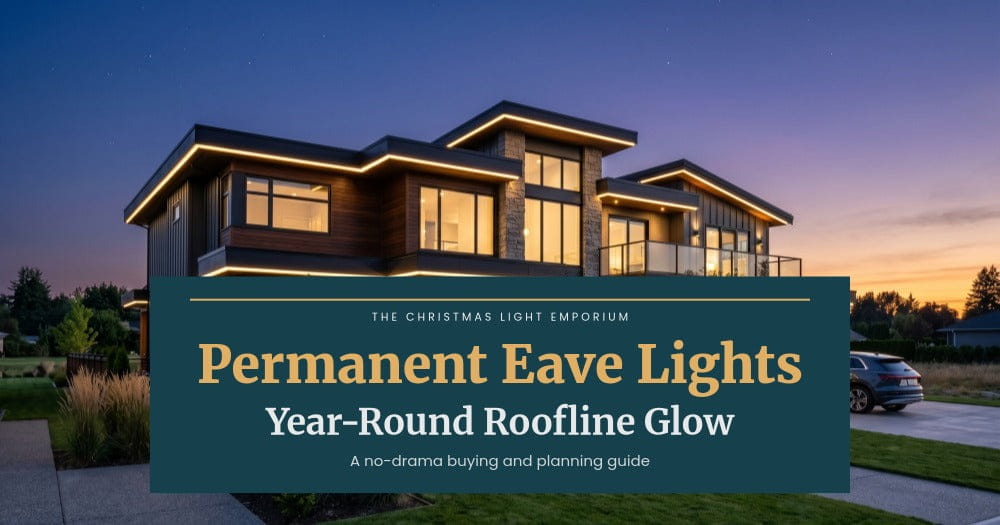
You've seen it: clean roofline lighting that looks "professionally installed" in December… and then it's still there in July looking just as intentional. That's the appeal of permanent eave lighting—a year‑round system designed to live under your eaves, ready for holidays, game days, backyard parties, and everyday curb appeal.
This guide breaks permanent eave lighting down the practical way: what to look for, how to plan your run, what to ask before you buy, and how to avoid the most common "I wish I knew that" moments.
If you're already shopping, start here: our Permanent Eave Lighting collection shows what a complete ecosystem looks like (controller, track, add‑on strings, and power accessories) so you can plan instead of piecing it together.
What is permanent eave lighting (and what makes it different)
Permanent eave lighting is an architectural lighting system designed to be installed along rooflines/eaves—typically using a track that mounts neatly under the fascia. Unlike seasonal Christmas light strings, it's meant to stay up all year and be controlled by an app or controller.
The "permanent" part isn't just about leaving lights up. It's about a system that's built for:
- Clean, straight lines (track helps a lot here)
- Consistent spacing (so your roofline doesn't look random)
- Outdoor durability (sun, wind, rain, cold)
- Programmable scenes (holidays + everyday lighting)
- Long runs without the weird dim/bright sections that scream DIY
The best systems look like they belong on the home—because they're designed as architectural lighting, not as a temporary string you're hoping survives.
Why homeowners switch to permanent eave lighting
Here's the real checklist people care about (not the brochure stuff):
1) You stop climbing ladders every year
No more "one windy Saturday in November" tradition.
2) You get more than Christmas
A good RGBW system can handle:
- Warm white for everyday curb glow
- Halloween (orange + purple)
- Game day colors
- Valentine's, St. Patrick's, patriotic themes
- Backyard party lighting that feels like a destination
3) Your roofline looks sharper
Track + consistent spacing creates that clean, pro look—especially on straight runs.
4) You can still do seasonal decorating—just smarter
Permanent eave lighting doesn't replace everything (wreaths, garland, trees are still a vibe), but it makes the biggest "outline the house" job effortless.
RGB vs RGBW: the choice that affects how "white" looks
Most people don't regret getting color control. They regret realizing too late that "white" isn't always white.
- RGB systems create white by mixing red/green/blue.
- RGBW systems add a dedicated white channel, which typically gives you cleaner whites and more flexibility.
If you like the idea of everyday warm white and holiday color, RGBW is usually the sweet spot.
Example: our OPL add‑on string is 48V RGBW and includes a dedicated white that can be adjusted across a wide Kelvin range (listed as 2000–8000K on the product page), which is exactly what you want for "everyday looks" plus "holiday mode." See the 48V RGBW Permanent Eave Lighting Add‑On String for the specs and spacing.
Voltage: why many permanent systems use higher voltage (and why you should care)
You don't need to be an electrician to understand this part—just remember one thing:
Longer runs make voltage drop more likely.
Voltage drop is what causes sections to look dimmer or act weird as you get farther from the power source. Many permanent eave lighting systems use higher voltage (like 48V) to help maintain consistent performance over longer distances.
If your home has multiple rooflines, peaks, or you're trying to wrap a big footprint, voltage is not a tiny detail—it's a "will I be happy with this in two years" detail.
Spacing: the "look" dial you're choosing
Spacing affects the whole vibe. Here's a quick way to think about it:
| Spacing | Look | Best for |
|---|---|---|
| Wider spacing | More subtle, architectural | Everyday glow, cleaner lines |
| Tighter spacing | Brighter, more "holiday" | Big impact, bolder displays |
On our OPL add‑on string, spacing is listed as 9.6 inches with 41 lights over 32.8 feet of lit length, which lands in a very "clean but still bright" range for most homes. (It's one of those specs that sounds boring… until you see it installed.)
Track: the difference between "permanent" and "leftover string lights"
If you want that clean pro look, track matters.
Track helps:
- Keep lines straight
- Hide wiring
- Maintain consistent spacing
- Make corners and transitions look intentional
It also makes maintenance less annoying, because you're working with a system instead of a bunch of separate clips and hope.
Our Permanent Eave Lighting collection includes powder‑coated aluminum track options designed specifically for the system (so you're not trying to invent your own mounting method).
Planning your layout: measure like a pro (without overthinking it)
Before you buy anything, do a simple planning pass.
Step 1: Sketch your roofline
You don't need CAD. A notepad drawing is fine.
Include:
- Straight runs
- Peaks
- Garage line
- Porch line
- Dormers / second-story overhangs
Step 2: Measure each run
Measure the fascia/eave length you want lit. Round up a little for transitions and "oops" moments.
Step 3: Decide what you're lighting (and what you're not)
Most homeowners don't need every inch of the roofline.
Common "high impact" priorities:
- Street-facing roofline
- Garage
- Front porch
- Strong architectural features (gables/peaks)
Step 4: Identify where power and control will live
You'll want:
- A logical spot for the controller
- A safe, protected power location
- A plan for getting from one roofline section to the next
This is also where you decide if you're DIYing, hiring a handyman, or using a pro crew.
On our Permanent Eave Lighting Bundle by OPL, RGBW, the product FAQ notes that installation time varies and mentions many professional crews can install significant footage per day—use that as a reality check for your own timeline.
A note on cost
Unlike temporary strings, permanent eave lighting is an investment that replaces yearly ladder work and storage hassle. Entry-length bundles for a typical facade start in the low thousands and scale with linear footage, track finish, and controller capacity. Because LEDs are efficient and long-lived — the U.S. Department of Energy notes residential LEDs use at least 75% less energy and can last up to 25× longer than incandescent lamps (DOE LED Lighting) — operating costs stay low compared to traditional strings. For a clear sense of what's included, review the Permanent Eave Lighting Professional Installation Bundle by OPL.
Power injection: what it is (and when you'll hear about it)
If you're building a larger system, you'll run into the phrase power injection.
Plain-English version: power injection is a method of adding power at points in the run so the system stays consistent.
On the OPL add‑on string product page, there's a note that if you expand beyond certain total run lengths, you may need additional power supplies for injection. That's normal for larger installs—just something to plan for early so you're not stuck mid‑project.
If your plan includes a big wraparound roofline, it's worth adding the Power Injection Kit for OPL Permanent Eave Lighting System to your "maybe" list while you plan.
Safety and outdoor rating: what to look for
Permanent eave lighting is outdoors 24/7, so "outdoor rated" is non‑negotiable.
When you're evaluating any outdoor power cords or accessories, one practical thing to know is that cords evaluated for water resistance are commonly marked with a "W" in the type designation—UL gives SJTW as an example. That "W" designation is part of how outdoor/wet suitability is identified on cord markings. See UL's explanation in their wire/cable application guide.
Seasonal and decorative lighting products are subject to safety requirements like UL 588, which addresses wire size, strain relief, and overcurrent protection — see the CPSC's overview of seasonal lighting standards. Look for UL/ETL listings and always follow the system's installation manual.
Also, holiday lighting is often on for long stretches (especially in December). In electrical code discussions, a "continuous load" is commonly defined as something expected to run at maximum current for three hours or more, and branch circuit sizing rules apply an additional 125% margin for those loads. Translation: plan power conservatively, use outdoor-rated gear, and if you're ever unsure about circuit capacity or installation method, ask an electrician.
The U.S. Consumer Product Safety Commission reported approximately 14,900 decorating-related emergency room visits during the 2022–2023 holiday season (CPSC holiday safety guidance). Most of those incidents are preventable with proper equipment and installation practices. The Electrical Safety Foundation International's outdoor checklist reinforces GFCI use, outdoor-rated cords, and keeping connections clear of standing water.
If you're still building out seasonal accessories for other parts of your display (trees, shrubs, windows), our Christmas Light Installation Essentials collection is a good "make it easier" hub for the non-permanent side of decorating.
Design choices that look great—and keep neighbors happy
Permanent systems are bright and flexible, so a little restraint goes a long way. DarkSky International and the Illuminating Engineering Society recommend five principles for responsible outdoor lighting: aim light where needed, use the lowest practical level, control runtime, and prefer warmer color temperatures at night.
- Everyday look: Choose warm white (2700–3200K appearance) at modest brightness for a premium, architectural glow.
- Holiday scenes: Use color sparingly for contrast—roofline in white with subtle color on peaks or entries feels polished.
- Schedules: Automate off‑hours; a dusk‑to‑late‑evening window keeps bills down and nights dark.
- Glare control: Track placement under the soffit helps shield pixels from direct view across the street.
Quick install overview
Whether you're DIYing or supervising a crew, here's what the process looks like:
- Prep and paint (if needed) — Dry-fit track sections, mark pilot holes, and paint raw aluminum to match trim if desired. Let everything cure before mounting.
- Mount track straight — Snap a chalk line, then fasten track with the manufacturer's screw pattern. Keep fasteners consistent for a tidy reveal.
- Route the harness — Follow the track path, securing the pre-spaced nodes per instructions. Maintain gentle bends and label each segment as you go.
- Place the controller and power supply — Mount in a dry, ventilated location near your GFCI-protected receptacle. Keep low-voltage leads tidy and strain-relieved.
- Make weather-smart connections — Elevate cords, create drip loops, and protect plug points from rain splash.
- Test, then aim for subtlety — Run a white scene first to spot gaps, then layer in colors. Save favorite scenes and an everyday schedule in the app.
Buying checklist: what to confirm before you commit
Use this list while comparing systems.
System + control
- Does it support scenes/scheduling?
- Does it have RGBW if you care about true whites?
- Are software/app updates supported over time?
Hardware ecosystem
- Is there a matching track option?
- Are extension cables available?
- Is power injection supported for larger installs?
Performance specs
- Voltage (helpful for longer runs)
- Spacing (determines the look)
- Warranty length (because this is not a one-season item)
Installation reality
- What's your plan for peaks/second story?
- Do you need help for ladders, drilling, or routing?
"Should I DIY permanent eave lighting?" (honest answer)
Many homeowners can DIY it if:
- You're comfortable on ladders
- You can measure accurately
- You're patient about straight lines and clean transitions
But "DIY" doesn't have to mean "do it alone." A handyman can be a perfect middle ground—especially if you want to handle planning and product selection, but don't want to spend a weekend 20 feet up.
A licensed electrician isn't typically required for the low-voltage portion, but you may want one to add an exterior GFCI receptacle, a new circuit, or to hard-wire the controller where code allows. Multi-story homes, tricky rooflines, or long ladder work are good reasons to hire a pro. Either way, pre-planning is 80% of the job—label your runs, stage hardware by facade, and test on the ground before you climb.
If you ever need help planning what to buy, our customer service team is known for being fast and thorough, and the site's help center makes it clear they strongly encourage email support for accurate answers. You can also start at the Customer Service Center if you want policies, FAQ access, and the help site in one place.
Maintenance and year-round uses
Great news: maintenance is minimal. Dust the soffits during your seasonal exterior cleaning, check the app firmware occasionally, and visually scan runs after severe weather. Beyond December, set scenes for Halloween, Fourth of July, birthdays, backyard dinners, and everyday architectural glow. Because the system lives in the track, your holiday storage box gets a lot lighter.
Common mistakes to avoid
- Skipping measurement slack: Order a touch extra to handle returns and transitions cleanly.
- Ignoring moisture management: Keep receptacles covered, connections elevated, and cords off the ground.
- Over-bright, all the time: Run whites at a lower level for the nightly look; save high output for special moments. DarkSky's principles are a great reference.
- Under-planning power: If you're also running trees, bushes, or other displays, plan branches and capacity as if you were designing a holiday circuit.
How to get a "Christmas roofline" look with permanent eave lighting
If your goal is a classic Christmas outline (not just "color"), here's the easy approach:
- Pick your white first (warm vs cool)
- Use color for accents (peaks, porch line, garage)
- Keep effects simple (steady or slow fades)
And if you still love the traditional C9 holiday bulb look on seasonal stringers (it's iconic for a reason), you can mix permanent eave lighting with classic bulbs elsewhere. Our C9 Christmas Lights collection is a great place to browse color options, including ProCore® lines.
FAQs
Will permanent eave lighting look weird when it's "off"?
Good systems are designed to be discreet when not lit—especially when installed in track that matches your home's trim.
Is it bright enough for everyday lighting?
Yes, and brightness is mostly determined by spacing, LED output, and how you program it. Many homeowners prefer a lower-intensity warm white scene for everyday use.
Can I still decorate traditionally?
Absolutely. Permanent eave lighting is your always-ready roofline base. Then you can add seasonal elements (wreaths, garland, trees) when you feel like going big.
Does weather matter?
Yes. That's why outdoor ratings and proper installation practices matter. Use systems and accessories designed for year‑round outdoor exposure.
How much does a permanent eave lighting system cost?
Total cost depends on your home's roofline footage, whether you choose a bundle or build piece by piece, and whether you DIY or hire help for installation. A good starting point is to measure your footage, then check our Permanent Eave Lighting collection to price out the components for your specific layout.
Can I control permanent eave lights from my phone?
Yes—most modern systems include app-based control for scheduling scenes, adjusting color and brightness, and setting holiday themes. The OPL system available in our collection supports app control, so you can switch from warm white to full holiday mode without touching a ladder.
Will permanent eave lighting increase my energy bill?
Typically, only modestly. LEDs are extremely efficient; the U.S. Department of Energy estimates residential LEDs use at least 75% less energy and last much longer than incandescent lighting. See DOE's overview here.
Can I expand later?
Yes. Many systems support add-on strings and extra track. Plan controller capacity and cable routes now so adding a dormer or side return is plug-and-play.
Ready to plan your permanent eave lighting system?
If you want year‑round roofline lighting that looks intentional (not improvised), start with an ecosystem that's built to work together.
Browse the Permanent Eave Lighting collection, then decide your run length, spacing vibe, and whether you're going RGBW for the best of both worlds.
And if you want a second set of eyes on your plan, reach out through the Customer Service Center—we'll help you keep it clean, safe, and completely no‑drama.
About The Christmas Light Emporium
The Christmas Light Emporium has been helping homeowners and professionals create unforgettable holiday displays since 2015. We specialize in commercial-grade LED Christmas lights engineered to perform season after season — from 5mm wide-angle LEDs and C9 stringers to specialty products like DreamSpark smooth-fade and SuperSpark strobe lights that you won't find anywhere else.
Every product we sell is tested against real-world conditions and backed by our industry-leading Reindeer Proof Warranty. Whether you're outlining your roofline for the first time or upgrading a neighborhood-famous display, we're here to help you get it right. Shop our full catalog and see the difference professional-grade makes.